Tuesday, November 25, 2008

Random Anime/Manga Term #239: Hikikomori

Hey y'all. I'm overdue for an update, so I'm posting the text and picture from a handout I've created for my Anime/Manga club describing the ever-popular hikikomori. It's pretty basic and probably familiar territory for some readers, so for that I apologize....


--------------------------------------------------------------------
Random Anime/Manga Term #239: Hikikomori


Meaning “to pull away” or “to be confined”, a hikikomori is someone that has decided to isolate themselves away from others and refuse all social interaction. The cause of the condition is unknown, but it seems that the intense social pressures of Japanese society - a very rigorous but boring school system, rigid rules of public behavior, and the typical challenges young people face when they’re transitioning into adulthood – can often prove so overwhelming to some that isolation is preferable.

Most hikikomori are in their teens and early twenties, and almost all seem to be men. A stereotypical hikikomori never leaves their apartment (or if they live with their parents, their bedroom), aside from going on late-night runs to the convenience store for food. They spend their time sleeping, watching TV, reading, or on the computer (Hey, that doesn’t sound half-bad! D) and survive on handouts from their family.

One of the most notable hikikomori in anima/manga is the title character of The Wallflower, Sunako. Those of you who dig the Peach-Pit body of work may be familiar with Rozen Maiden and Jun, it’s hikikomori protagonist; Welcome to the NHK also has a hikikomori protagonist, Sato.

You probably won’t see a hikikomori nearly as much as you’ll see a tsundere character (remember her?) in the manga you read and the anime you watch, but keep an eye open for him….they’re controversial folks in Japan, so manga artists and anime creators have definitely included them in their work.

References:
http://en.wikipedia.org/wiki/Hikikomori

Wednesday, October 15, 2008

NY Anime Fest – Friday Sept 26th

Once again, I was fortunate to attend the New York Anime Fest for free as a “professional”….sweet. Unfortunately, I was stuck with work and personal obligations so I was only able to attend on Friday, the opening day, and only for 4 hours at that. Still, I had a blast taking in screenings (Lucky Star), attending panels (“How to Make in Anime Journalism”…hey, a guy can dream right?), and of course, shopping for Bleach crap while gawking at the cosplay crowd.

I had trouble getting into Lucky Star the first time I saw it, so I figured I’d give it a second try at the 2:45 screening (it was either that or the Naruto: Ninja Clash in the Land of Snow movie…which appeared to be completely unattended, hahaha). Like the Melancholy of Haruhi Suzumiya, I’d heard the hype about Lucky Star but it just didn’t match up to my expectations; it struck me as being a less whimsical, more self-aware and chatty version of Azumanga Diaoh populated by 4 Ayumi “Osaka” Kasugas – a loosely-plotted, character-driven comedy “show about nothing”, ala Seinfeld.


I definitely liked the looseness and goofiness of Lucky Star, but the jokes never really seem to connect; it just devolves into a lot of shaggy-dog stories about food and homework. Still, I do have to give it credit for its deadpan humor and self-deprecating jabs at otaku culture; maybe more episodes would change my mind.

The panel on anime journalism was enlightening, but the basic advice of humility, hard work, and professionalism wasn’t a whole lot different than the advice most aspiring writers are given. The basic message I got? To (badly) paraphrase AC/DC, “It’s a long way to the top if you want to be paid money write about Japanese cartoons”.

In terms of cosplay, the many, many characters of Naruto made a strong showing, but number of folks dressed as Bleach shinigami was pretty impressive too. Loligoths, maids, and Haruhis were in abundance (as to be expected), and I noticed that several folks were done up in Gurren Lagann gear; in fact, FUNamation promoted the series with some cosplay cheesecake. However, the highlight for me was one creative guy dressed as the title character from my personal fav-rave, Sayonara Zebutseuo Sensei! Nice work, dude. I tried taking a few photos with my cell phone of various cosplayers but the results were blurry and pitiful….

In any event, I was going to include pictures and descriptions of all my purchases, but I think that’s better off in a separate post; for those of you dying to see the Rukia figurines and Full Metal Panic DVDs I purchased, I’m afraid you’ll have to wait until next week….

Monday, September 15, 2008

Manga Review: Kekkaishi v. 1 (w/ bonus mini-Manga Review: Othello, v. 1 + 2)

Today I’m taking a look at two works from different ends of the spectrum: the “uber shonen”-style Kekkaishi and the winsome shojo Othello. First, Kekkaishi...


Although Yoshimori has inherited the power and abilities of his family’s demon-hunting art, he’s reluctant to truly commit himself to his duty of carrying on the family business of protecting the community…until his neighbor (and crush/childhood friend), rival demon-hunter Tokine is seriously injured by his inattention and half-heartedness. 5 years later on, Yoshimori is far more committed - but his stubbornness, uncontrollable sweet-tooth, and unabated crush on Tokine are still causing problems. As their local high school/junior high is the magnet for all sorts of ghouls, ghosts, and goblins, Yoshimori and Tokine (along with their spectral canine sidekicks, Madarao and Hakubi) have to learn to stop butting heads and instead team up to fight the endless array of evil spirits threatening their school.

Kekkaishi is prime example of the current shonen style of manga: an excitable, impetuous young hero who’s enormously talented (but stubborn and sort of lazy) has to hunt down rouge spirits and angry demons with the help of a loyal but wise-cracking sidekick; some readers out there will probably recognize this as being the exact plot as Bleach. The “excitable but lazy young guy” has long been a stock manga hero, but “demon-hunting” heroes seem to be especially popular these days; in fact, I’d say it’s replaced the Dragonball Z-style “ultimate fighter”/brawl as the shonen formula de jour (The “supernatural” has long had long been a popular topic in Japanese culture, and an astute anime/manga buff can observe it has provided the base of a wide range of current manga and anime – see XXXholic, Princess Resurrection, Hell Girl, Vampire Rosario, etc).

Still, formulaic as Kekkaishi is, there are some redeeming qualities. The occasional use of traditional Japanese ukiyo-e “ghost pictures” is a nice contrast to the sturdy, simple artwork that makes up most of the manga. The clan rivalry between Yoshimori’s and Tokine’s families harks back to old samurai traditions, but it’s cleverly played for humor: the “rival clans” act more like argumentative neighbors fighting over lawn clippings rather than inheritors of a proud warrior culture.

Although it’s not breaking any new ground, Kekkaishi at least succeeds in being a straight-forward and accessible take on the current shonen formula; older readers will have probably seen it all before, but younger ones will eat it up.
____


I also wanted to mention Othello…yes, the Shakespeare classic. Haha. Naw, by Othello I mean Satomi Ikezawa’s shojo manga, named for the board game Othello. Longtime readers know I usually steer clear of the shojo stuff (those huge, glistening eyes just creep me out, honestly), but a chance reading of vols 1 and 2 reveled Othello to be an entertaining take on the old Jekyll and Hyde formula: Yaya is a quiet, shy, bullied high school girl who occasionally transforms into Nana, a flamboyant, bad-ass rocker chick that’s prone to acting on Yaya’s repressed yearnings…specifically, enacting revenge on Yaya’s cruel classmates and boldly flirting with Moriyama, the handsome musician Yaya’s been quietly crushing on.

With a tight, plot-driven structure, Othello lacks the complex social/romantic structure of many shojo manga, and focuses more on purely Japanese growing pains – bullying, Loligoth cosplay, J-Rock, and a still-traditional relation between the sexes. The artwork also tends toward realism, i.e. no over the top bishonen/bishojo, chibi sidekicks, or overly cutesy characters. Both of these factors will make Othello attractive to older or occasional manga readers – guys too.

Monday, September 8, 2008

Excuses, Excuses....

Yes, it’s been over a month since my last update, and I might as well apologize now for not having posted a review for such a long time. My excuse? Well, I moved in with my girlfriend a few weeks ago, so that has been sucking up a huge part of my free time and prevented me from being able to read or watch much in the way of “modern Japanese visual culture”; in fact, I’ve got Mushi-shi and Beck: Mongolian Chop Squad DVDs gathering dust on top of the TV and Excel Saga, Kekaishi, Dororo and The Wallflower at the bottom of my bookbag accruing overdue fines.

So Gomennasai (ごめんなさい。) everyone….I will return to my normal schedule (i.e. still irregular but more frequent) of posting before long - I’ll be taking a look at a couple of the afore-mentioned series and coming back with news from the New York AnimeFest in a few weeks to boot.

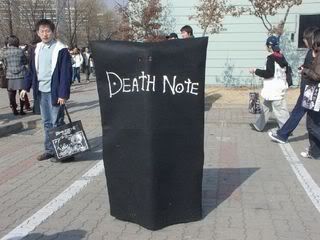
Until then, enjoy this creepy cosplay picture. Yikes…..


Thursday, August 7, 2008

ANIME REVIEW - The Melancholy of Haruhi Suzumiya


Like most teens, high school freshman Kyon is trying to make peace with what he believes is a profoundly dull existence. When his attractive but eccentric classmate Haruhi announces to their class that she “only wants to meet espers (psychics), aliens, and future men”, Kyon’s teasing convinces the strong-willed and haughty Haruhi to form her own club devoted to finding the afore-mentioned psychics, aliens, and time travelers – and Kyon is to be her first member, willing or not! Haruhi’s forcefulness soon finds the pair an unused club room, and Haruhi soon recruits/strong-arms 3 other classmates into joining the “SOS Brigade”: the quiet, bookish Yuki, handsome and easy going Koizumi, and the sweet but timid Mikuru. Despite Haruhi’s demanding personality, all seems fine…until the 3 new members privately reveal to Kyon that they are, in fact, either an alien (Yuki), a psychic (Koizumi), or a time traveler (Mikaru). Furthermore, they have all been sent to monitor Haruhi – who they believe has the unconscious ability to alter reality and the fabric of time and space itself! The only way to prevent serious damage to the universe is to keep Haruhi entertained and to go along with her whims…but can the cynical Kyon keep up the façade?

***

Judging from the both the number of Haruhi Suzumiya cosplayers and MoHS-related merchandise I’ve seen, I was well aware of the MoHS phenomena going in; and when Koizumi, Yuki, and Mikaru each revealed the nature of Haruhi’s powers, I began to look forward to the idea that the series was going to a weird philosophical turn. Unfortunately, this plot element is never really resolved; it’s left as a red herring, and is only occasionally referenced later. And what does happen in the series is, well, a little lame: Haruhi cons a computer off the school computer club! Haruhi solves a (fake) murder! Haruhi makes the club join a baseball tournament! Haruhi dresses in a bunny-girl costume and plays rock n’ roll at the school fair! Golly!

This is all entertaining and charming, but its rote - nothing that hasn’t been done in any number of high-school comedy anime series. MoHS definitely has flash, great art, and likeable characters, but there’s just not a lot of substance – at least, not enough to deserve all the hype it’s gotten. The interesting ideas and plot twists you encounter early on don’t amount to anything; it’s as if the original scriptwriters quit in the middle of the series and were replaced by “high school high-jinks” hacks.

Still, this series has one highly redeeming quality: Haruhi. The fact that she’s actually a strong, attractive, assertive, and smart female lead character that isn’t stuck doing panty-shots the whole series is a refreshing change; I can understand why so many female anime fans are fond of her. I wouldn’t call this a feminist anime (Haruhi’s “forced cosplay” with Mikaru borders on molestation), but the sex jokes are practically non-existent, the female characters are multi-dimensional and not treated like objects, and the male characters (well, Kyon and Koizumi) are thoughtful, sensitive, and obliging; even the cheesecake shots of Yuki, Mikaru, and Haruhi are tastefully done.

To sum it up, MoHS is a big letdown in terms of plot, but enjoyable if you just focus on the characters. I still think there are far better series out there under the radar (cough cough Welcome to the NHK cough Sayonara Zetsubou Sensei cough cough) but MoHS has a charm all it’s own.

Thursday, July 17, 2008

Manga Review – Pumpkin Scissors Vo1 1 and 2 by Iwanaga Ryotaro


Although the terrible war between the Empire and the Republic of Frost has ended, the war’s horrors remain – destruction, disease, hunger, crime, and corruption. In an attempt to try and remedy some of the situation, the Imperial Army has created State Section III (aka “Pumpkin Scissors” for its ability to “snip” through the thick “pumpkin shell” of corruption and desperation) to combat banditry and aid in the relief and reconstruction of the Empire. But with little respect and even less funding, Pumpkin Scissors - and it’s proud but strident field commander 2nd Lt Alice L. Malvin – have their hands full combating the crime and deprivation that plagues the Imperial countryside. When the platoon receives assistance from a kindly but mysterious ex-solider named Randel Orland, they’re shocked to find out that the “gentle giant” they befriended is actually a former member of a secret tank-killing brigade - and a deadly and unstoppable killing machine in his own right. With Randel at their side, Pumpkin Scissors must confront angry civilians, bent politicians, and thuggish ex-soldiers, and a secret and bloodthirsty military organization known only as the “Invisible 9” - who may hold the key to Randel’s mysterious past….

Similar to the classic Patlabor series in it’s “bad division” formula (i.e. a misunderstood and unpopular brigade of talented eccentrics use their skill and bravery to slowly win the respect and admiration of friend and foe alike), PS wins points for it’s setting and characterizations; Iwanaga creatively choose to set the series in a fictional version of 1930’s Europe (albeit with slight Japanese social overtones), with the resulting technology of the day – without wireless radios, jets, or submachine guns, the action is a gritty mix of tanks, rifles, and sheer guts. Iwanaga also uses humor to good degree; with the exception of Randel, the personal of Pumpkin Scissors are obviously pencil-pushers unsuited to the stress of actual combat. The art is a little rough at first but soon improves to a style that’s both cartoonish and sharp, and the action scenes are exciting and well-rendered.

All in all, Pumpkin Scissors is a well-done and straightforward action series with elements of humor and political intrigue; I look forward to subsequent volumes.

Thursday, July 10, 2008

Manga Review - A.I. Love You – Vol 1 by Ken Akumatsu


Ken Akumatsu is known primarily through his seminal harem comedy Love Hina (hey, another Love Hina ref on this blog! What does that make, #476?) and his newer magical action/fan-service extravaganza Negima! Master Negi Magi…but before he truly began to master the art of panty-shots, he wrote this series. And wow, what a difference 5 years makes in terms of a mangaka’s abilities.

Computer nerd Hitoshi gets absolutely zero female attention – with the exception of No. 30, the kind and caring life-like Artificial Intelligence program he’s created on his computer. When a freak electrical storm turns No. 30 into a real girl, Hitoshi must juggle their nascent relationship with her weird powers and origin….

Yeah yeah yeah, we’ve heard all it before!

Now, I dig rote manga storytelling as much as the next dork, but I’ll be damned if this isn’t a dull retread of Ah! My Goddess (mixed with a little of Weird Science). Shall we count the similarities?


1. Hero is physically unimpressive, has few talents (aside from some technical skills), and is unpopular with the ladies.
2. Despite being somewhat naïve, the Heroine is caring, giving, beautiful, and utterly devoted to the Hero.
3. Heroine can communicate with and control electrical/mechanical devices.
4. Heroine has two female “siblings” that appear later in the series – a sexy older one and a precocious younger one.
5. Artwork goes from awful to awesome over the course of the series.
6. Characters all attend Nekomi Institute of Technology (joke).

From what I’ve seen of A.I. Love You (which I grant is only Vol. 1), its best left to Akumatsu nuts or people who love the Ah! My Goddess “magical girlfriend” formula so much that they’re willing to read a sub-standard copy.

Still, we all have to start somewhere, and a talented mangaka like Akumatsu can be forgiven for crude artwork and a derivative storylines in their early work – part of the joy of manga (and graphic novels in general) is seeing the creators grow and mature over time.