Wednesday, May 6, 2009

MANGA REVIEW - How Not to Draw Manga, by Christ Reid and John Katz


As much as we love the big-eyed, small-mouthed citizens of anime/manga-land, it needs to be said that most, if not all, of what otaku like us read and watch is…well, mildly ridiculous. Deny it if you want, but you have to admit that your love for bishonen, mechs, and unlikely harem comedy (guilty as charged!) probably isn’t something you mention freely in mixed company, much less to members of the opposite sex.

This is why I’m delighted to have come across How Not to Draw Manga, an lovingly tongue-in-cheek OEL guide to the myriad cliché’s, stereotypes, and hackneyed plots that we’ve come to know and love. Chris Reid and John Katz come in with guns a’blazin’, taking on nearly every aspect of manga – the fact that there’s basically only 6 characters in manga (try matching your favorite characters to the formula – it’s truer than you know!); the inevitable fanservice, whether it be the moe characters (glasses, cat ears, etc) or just the dozens of ways to include a panty-shot into even the slowest story; and the obligatory “chibi”/adorable mutant animal sidekick. They walk you through all the clichés of character, setting, and genre, picking and choosing among them to create a frighteningly decent samurai/sorcery mini-manga at the end.

If I had a complaint about this work, it’s that it needs to be longer and in more detail – Reid and Katz do a fine job skewering manga, but they barely skim the surface of manga ridiculousness; I’d have loved to see them take on school comedy, gal games, hentai, and the otaku lifestyle itself.

Although the satire is pretty sharp, it’s clear that they absolutely love manga – “panties, robots, and brooding villains” alike - and just want to poke some much-needed fun at the art-form’s tired cliché’s. Highly recommended for aspiring mangaka, newbie otaku, and grizzled old dorks (like yours truly) too.

Monday, April 20, 2009

MANGA REVIEW – Oishinbo A la Carte: Japanese Cuisine and Oishinbo A la Carte: Sake, Story by Kariya Testu/Art by Hanasaki Akira

What up anidorks? Today I’m taking a look at a series that I’ve long desired to read, but haven’t been able due to dearth of Haute Cuisine-oriented manga scanlations on onemanga.com – Oishinbo (aka “The Gourmet” in Japanese).


Although lazy and ill-tempered, journalist Yamaoka Shiro of the Tozai News nonetheless possesses one of the most refined palates in Japan – a trait he inherited from his cold, overbearing father, the noted gourmand and artist Kaiban Yuzan. When Yamaoka’s head editor decides to celebrate the paper’s 100th anniversary by publishing the “Ulitmate Menu” – a selection of the finest dishes Japan has to offer – lackadaisical Yamaoka is reluctantly pressed into creating the menu. When he finds out that his father has teamed up with a rival paper to create their own “Supreme Menu”, Yamaoka and his gal-pal/writing partner Kurita Yuko must go head to head (and taste-bud to taste-bud) with Kaiban to find the finest foods in all of Japan!

Rather than publish the whole run (26 years and still going!), Viz has taken the approach of collecting specific chapters from the series dealing with a particular element of Japanese food (i.e. Sake, etc), and creating an “a la Carte” collection of chapters in single volumes. For readers not entirely familiar with the nuances of all-rice sake and the correct way to filet seabream, this offers an easy introduction to Japan’s rich and fascinating food traditions. Casual/lazy reviewers will inevitably compared Oishinbo to Tampopo or Iron Chef, simply because it looks at the unique food culture of Japan in relaxed, easy-to-approach manner. That’s a shame really, because Oishinbo is a work that deserves recognition for its own unique perspective; although there is the occasional plot twist, character development, and cliffhanger endings, it’s less of a narrative-oriented manga and far more of an overview of Japanese cuisine in graphic novel form. Art buffs might find the character design a little rough and dated at times, but it’s obvious that artist Hanasaki is instead focusing on the main element of the series – the food, loving depicted and almost leaping off the page.

It should be said that Oishinbo is probably best for adult readers, but not because of any thematic elements: aside from heated arguments over the best way to serve champagne or the time it takes to learn the techniques of sashimi, the violence and sex is absolutely non-extant. There’s a good chance the series will probably go over the head of most teen manga readers (and to be fair, the numerous adults that think fine dining means Applebee’s), but if you have interest in culinary history or want a unique look at Japanese culture, I can’t recommend Oishinbo enough.

Tuesday, March 31, 2009

UPDATE: Bleach SOULs/Anime-themed Video Games/The End of Anime Insider

What up anidorks? I’m just checking in today, so no reviews. In all honesty, I haven’t really come across anything worthy of a review lately*, so rather than waste my time and yours enthusing about/savaging some nameless shonen action series, I’m just gonna ruminate on a few topics…


First off, devoted Bleach fans should do themselves a favor and pick up the Bleach SOULs. Official Character Book at their earliest convenience. It’s a great overview of the series present storyline up to Vol 21, as well as containing biographical info for all 80+ characters. Throw in an interview with Tite Kubo, glossary of terms, and a bunch of bonus manga and you’ve pretty much got a “must have” for Bleach heads (along with Kon-patterned underpants).

Secondly, the latest Anime Insider magazine is devoted a whole issue to “Video Games for Otakus”, a subject near and dear to my heart. In fact, they do a fine job of tabulating the “otaku quotient” (i.e. number of anime/Japanese culture – specific titles) for the current console systems. I’ve been struggling to find the system with the most otaku-friendly titles, and I guess it’s no surprise that (spoiler) the Nintendo DS wins out there. I’d suggest hot-footing down to the local newsstand to pick up a copy – not just because of the content, but because Anime Insider will be stopping publication as of this issue, #67. Another one bites the dust, sadly….


And speaking of anime-friendly video games, I’m dying to see a North American version of Sunday X Magazine: Taisen Action, Trigger Heart, a side-scrolling 2D fighter starring the characters from Japanese manga magazines Shonen Sunday and Shonen Magazine. The cast includes characters from Negima (awesome!), Fairy Tale, Air Gear, Cromartie High School, Inu-Yasha, Hayate the Combat Butler, and Kekkashi, as well as several other Japan-only series. If you simply must have a copy, its $60 and in Japanese…but I doubt that’ll stop some of you.

In any event, it’s a lovely spring day outside….and naturally, I plan to spend it indoors watching the original Tenchi Muyo OVA and playing Suikoden III (har har).


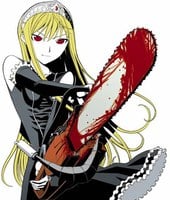
* with the notable exception of the awesomely funny (and disturbing gory) “magical girlfriend” parody series Bokusatsu Tenshi Dokuro-chan, aka “Club-To-Death Angel Dokuro-chan”.

Thursday, March 12, 2009

I forgot to mention....

...that Del Ray released Sayonara, Zetsubou-Sensei V.1: The Power of Negative Thinking on February 24th. You can get it from the usual retailers, and I highly, highly recommend this a purchase for any forward thinking manga or graphic novel fan. Joyce Aurino and Del Ray have done an excellent job of translating and adapting this Japanese Pop-Culture-centric series for western readers; the print version is a definite improvement over the fan-scans I’ve come across. Feel free to check out my gushing review from last June if the mood strikes you....

Wednesday, March 11, 2009

Manga/Anime Review - Princess Resurrection


What up anidorks? I’ve decided to spare you from the usual comedy series and instead take a look at supernatural action series Princess Resurrection.


In thanks for his attempt to save her from a fatal accident, Hime – daughter of the King of Monsters – has granted middle schooler Hiro the gift of eternal life, but on two conditions: First, Hiro must partake of Hime’s blood every few days lest he dies; and secondly, Hiro must remain her servant/bodyguard for eternity as payment. It’s apparent that Hime needs all the help she can get, as her numerous brothers and sisters are intent on killing her and each other to achieve the royal throne. Hime's cohorts - half-breed werewolf Liza, opportunistic vampire Reiki, and Hime’s robot servant Flandre - all have the power to fight of the rival siblings and vengeful monsters out for Hime’s blood, but what can young Hiro do to help protect the life of his new master?

Supernatural-based anime and manga has seen a renaissance as of late, and PR is a solid offering in this genre. Series creator Yasunori Mitsunaga deviates from the popular “vengeful spirits” theme common in contemporary anime and manga*, and instead draws on the “classic horror” of 1950’s drive-ins (ala vampires, werewolves, zombies, and creatures from the Black Lagoon…can the Blob be far behind?) to power this series. Although I do enjoy the more subtle and elegant vibe of traditional Japanese horror, the blood-and-guts, monster-on-monster action of PR is definitely appealing for those of us who grew up on Boris Karloff and not Lufcadio Hearn. Hiro’s persistent need for Hime’s blood adds a nice bit of nasty (and a subtle erotic undertone) to this relatively straight-forward and action based shonen manga series.

That having been said, those of you who are able to view the anime series via ADV or the Anime Network will notice how the series has been “cleaned up”, for lack of a better word – rather than sup on Hime’s blood, Hiro instead gets the gift of Hime’s “Life Flame” (yeesh). It’s a shame that this integral plot element was modified in such a way, but that’s show biz I guess. Along with the overall lower level of gore, I find that the anime also removes a fair amount of gothic creepiness that Mitsunaga was able to impart via his artwork.

Still, the anime is a pleasant enough diversion (particularly after dark!) and the manga series deserves a read from horror and action-lovers alike.

*xxxHolic and Mushi-shi, for example.

Wednesday, February 18, 2009

Anime Review: Toradora


The “psycho eyes” that high school sophomore Ryuuji inherited from his dead gangster dad have terrified his classmates into believing he’s a violent juvenile delinquent – although in actuality he’s just a kind, mild-mannered, and somewhat lonely young fellow. When he finds out that his crush Minorin, the friendly yet airheaded captain of the girl’s softball team, will be in the same class as him, Ryuuji is overjoyed; that is, until he runs afoul of Minorin’s best friend – Aisaka Taiga (aka the “Palmtop Tiger”), whose small size and delicate, doll-like appearance belie her foul temper and capacity for ultra-violence. Barely surviving the encounter, Ryuuji finds a love letter in his bookbag. It’s addressed not to him but Kitamura, Ryuuji’s studious best friend - and it’s from none other than Taiga herself, who seems to have placed it in Ryuuji’s bag by accident.

Bemused by the situation, Ryuuji returns home, only to be awoken at swordpoint by a crazed Taiga, who’s determined to kill Ryuuji for finding out her secret crush. In order to dissuade the pint-sized psychopath from her intended act of murder, Ryuuji vows to help Taiga win Kitamura’s affections; and in thanks, Taiga half-heartedly vows to help Ryuji win Minorin’s love. Their alliance now sealed, Ryuuji and Taiga are soon secretly meeting up during school to plan their “twin-love attack”, but their frequent planning sessions are misconstrued by their classmates as lover’s trysts. Naturally, this rumor makes its way to both Kitamura and Minorin, who become increasingly reluctant to return Ryuuji and Taiga’s ham-fisted flirtations. The arrival of big-city girl Ami, Kitamura’s childhood friend, adds another stumbling block: Ami’s prissy attitude embarrasses Kitamura and infuriates Taiga – but it becomes slowly apparent that Taiga’s rage may less to do with Ami’s big-city airs and more to do with her teasing flirtation with a clearly uncomfortable Ryuuji.

Before long, Taiga has become increasingly reliant on Ryuuji to look after her welfare, a situation that Ryuuji originally views with annoyance, but does little to reverse; she is a truly a “poor little rich girl”, funded by wealthy parents that don’t particularly seem to care for her. Ryuuji, on the other hand, lives in somewhat depressed circumstances – i.e., a rundown apartment shared with his deformed pet canary and boozy bar hostess of a mother who immediately takes a shine to both Taiga’s brassy attitude and increasingly frequent appearances at dinnertime.

Circumstances seem to be drawing Ryuuji and Taiga closer and closer together…but can they allow themselves fall in love with one another?

***

Toradora has it’s origins as a series of light novels*, and it retains a level of literary complexity that one doesn’t often find in “high school hijinks/love comedy” manga and anime. This, of course, work greatly to its credit; yet – as fine as this series is – I have to admit that I often struggle to understand the interactions between Ryuuji and Taiga. Their mutual affection is certainly implied, but there seems to be so little proof; their behavior toward one another is either so combative or hesitant that’s unclear what their real feelings are. During the episodes, I catch myself wondering aloud “Is he really in love with her? Is she in love with him? I don’t get it.” Perhaps the very real Japanese/American cultural gulf is to blame for my confusion, or maybe it’s just my masculine lack of emotional acumen. Still, the fact that Toradora’s emotional nuances are difficult to figure out absolutely wins Toradora my favor; I wish more series would demand even a mild level of challenging interaction from their viewers/readers.

Longtime readers of otakupubliclibrary know that I enjoy/willingly suffer through many a “love comedy”, and it’s my humble opinion that Toradora is probably one of the best and most honest depiction of teen romance currently playing on otaku computer screens – it depicts the frailty of first love without being weepy or wimpy in slightest. Furthermore, this series wins my plaudits because of the fact it’s easy for readers/viewers to visualize both a happy and an unhappy ending to this series; as much as I can see Ryuuji and Taiga together in the end, part of me realizes (and at times, genuinely prefers the fact) that it’s more realistic to see Ryuuji and Taiga both ending up lonely and heartbroken at the series’ conclusion.

I’m aware that a lot of YA librarians wrestle with the problem of using manga as teen literature; Toradora would probably please the “teen issues/problems” crowd that seems to dominate the dialog over teen lit….were it actually being published in the USA. Currently, there are no plans by any North American/European company to release English-Language versions of the original novel, manga, anime, or “visual novel” that have been proved so popular in Japan…shameful, If you ask me.

That having been said, if you simply must flout international copyright law, one can find fan-subbed Toradora episodes available for downloads on several questionable websites; likewise, the clever otaku may find links to a fan-translated version of the light novels through Toradora’s Wikipedia entry. You didn’t hear it from me, kids….

*a uniquely Japanese term for teen-oriented novels with manga-style illustrations; basically, not too different from the stuff you’d see in the Young Adult section in your local Public Library, except with themes more common to anime and manga and/or to the lives of Japanese teens.

Tuesday, February 10, 2009

NY Comic Con 2009


Yes indeed, it’s that time of year again - New York Comic Con '09.

My buddy Christian from the QBPL invited me to present the “Otaku Collection Development: Taking Your Collection to the Next Level” panel with him on Professional Day, Friday Feb 6th. Christian covered vintage works: darker Tezuka (MW, Ode to Kirihito), J-Horror (Drifting Classroom), and hack-and-slash Samurai stuff (Lone Wolf and Cub, Lady Snowblood). I covered accessible but under-the-radar modern manga (ala Yakitate Japan, xxxHolic, and The Melancholy of Haruhi Suzumiya), as well as modern fringe stuff (ala Welcome to the NHK and Sayonara, Zetsubou-Sensei).

Personally, I thought we did dang good, although a blogger flamed us as being sexist because we didn’t talk about shojo. Ouch. In our defense, we were sandwiched between two shojo-centered panels, and we felt like more shojo on our part would have been overkill (although some people obviously don’t agree). Besides, you have to admit that something about two burly 30-something guys with huge red beards talking about comics geared to 14 year old Japanese girls comes off a little....well, creepy. Eh, whatever.

In any event, the Con itself was ok, but way more crowded than I remembered from last year; I suppose folks are in need of escapist entertainment more than even. I ran into an old manga-loving coworker, which was awesome; she had been “relived” of her job rather unfairly (at least in my opinion), so I was happy to hear that she was doing well at her new gig. Unsurprisingly, I went bat-poop crazy in the retailer section and picked up about 20 manga; the volumes were only about $4 each because I bought in bulk, so I grabbed a random selection of stuff I’d been either meaning to read, or just looked appealing…

-Comic Party #1 and #3 (Doujinshi artist-themed slapstick comedy; way weirder than the anime it spawned.)

-Neon Genesis Evangelion: Angelic Days #1 (NGE re-imagined as a school comedy/drama…an interesting idea, that’s for sure.)

-Ai Yori Aoishi #2, 6, and 8 (cloyingly sweet Love/Harem comedy. What can I say? I just can’t keep my hands off this crap.)

-Lupin III #9 (Classic seinen heist high jinks)

-Martian Successor Nadesico #1 – 4 (lighthearted space opera; the dated art and “flipped” format make it hard to get into, but I dig the series.)

-Cyborg 009 #8 (old school action/intrigue stuff with big Tezuka visual influence.)

-Samurai Executioner #3 (1970’s hack and slash Samurai action)

-Onegai Twins (dopey Harem comedy that, of course, I can’t resist)

-Iron Wok Jan #12, 14, and 23 (Chinese cooking showdown; way more dark and intense than you would imagine a cooking showdown series to be…)

-Those Who Hunt Elves #7 (action/comedy/fantasy/adventure about a man, two women, and a tank trapped in the land of elves. Raunchy plot elements but far more goofy than echi)

I also picked up ADV’s Martian Successor Nadesico box set; dated as it is in terms of it’s sci-fi theme and animation, I liked the bit that I was able to get through Netflix so I didn’t mind coughing up for copies of my own.

All in all, a dang good time – and not nearly as stinky/creepy as the NY Anime Fest!

***


Otherwise, things are pretty chill here at the biblioteca publica dé Otaku. Aside from watching the excellent Toradora and the offbeat Akikan (teen boy’s soda can transforms into a beautiful girl who must battle other soda-can/girls for “can supremacy”), I’m taking a real shine to Paranoia Agent, a supremely creepy psychological/crime thriller about the manhunt for a baseball bat-wielding boy on rollerblades; expect a review of one of these series (or Comic Party) before long.